
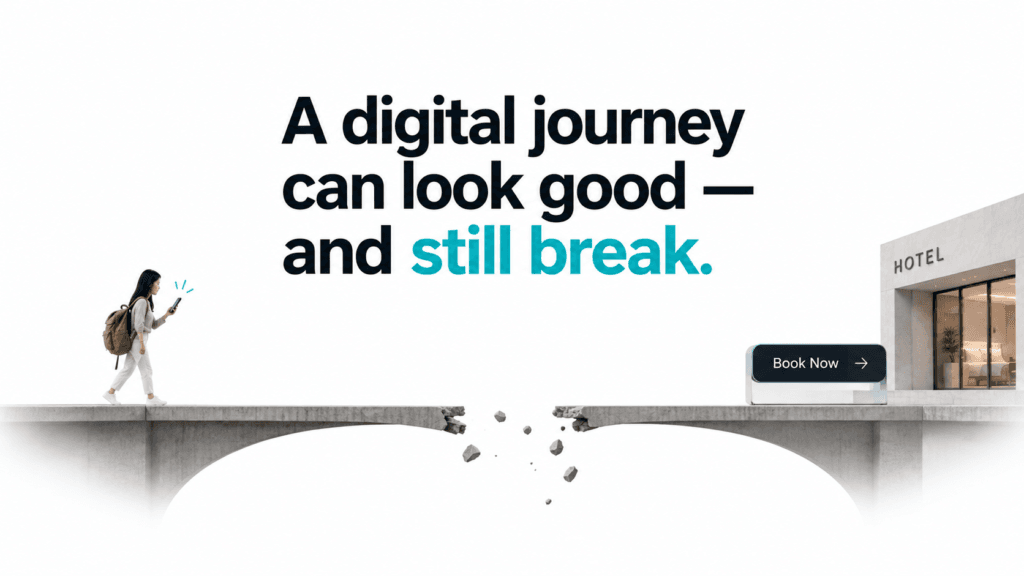
A digital journey can look good and still break.
Over the past few months, we reviewed 300 hotels research across Cambodia, Thailand, and Vietnam 100 from each country.
We weren't trying to decide which country has better hotels. We wanted to understand something more useful: what happens when a traveler moves from finding a hotel to actually taking action?
The problem isn't always the website.
A hotel might have a beautiful website.
It might appear on Google, have strong reviews, active social media, and even have a clear “Book Now” button.
But what happens after the guest clicks?
Cambodia
Our Cambodia research recorded action-path or contact-journey issues in 22 of the 100 hotels reviewed.
Thailand
In the Thailand dataset, 27 hotels showed partial evidence and 2 showed weak evidence around the action or booking path. The remaining records were generally stronger or not fully verified.
Vietnam
Many hotels clearly promote direct booking, special rates, and best-rate guarantees. But in many cases, the actual checkout experience could not be fully verified from publicly observable information.
These findings aren't a ranking of the three countries. The research methods and evidence available for each market are not identical enough to make a simple country-versus-country scorecard.
What we were looking for was something else: recurring patterns we can learn from.
Having a booking button is not the same as having a smooth booking journey.
And then something can change.
The information may be unclear.
The booking path may move to another system.
The guest may have to provide more information than expected.
Availability may not be immediately clear.
Or the next step may simply not be obvious.
None of these issues necessarily looks serious on its own.
But together, they can create uncertainty at the exact moment a customer is deciding whether to continue.
This is what the 300-hotel study taught us.
A hotel doesn't have just one digital channel.
The customer experiences a connected journey across search, maps, websites, social media, reviews, booking platforms, and direct contact.
So when one part doesn't connect well with another, the problem isn't always a “bad website.”
The problem may be the connection between the parts.
We also learned to be careful about what we claim.
We can observe what is publicly visible.
But technical configuration, analytics, structured data, and other behind-the-scenes systems require deeper checking and human verification.
That's important because a public website can tell us a lot but it doesn't tell us everything about what is happening behind the scenes.
Why this matters to SYNQFORM
This research is one of the reasons we developed Master SQA SYNQFORM's structured digital assessment methodology.
It gives us a systematic way to look beyond individual channels, bring evidence together, and understand what is actually happening across the digital journey.
Research first. Evidence first.
Then decide what actually needs attention.
Let’s look at your direct booking paths together.
If you want to review your current digital setup and see where your booking routes need strengthening, let’s have a practical conversation.