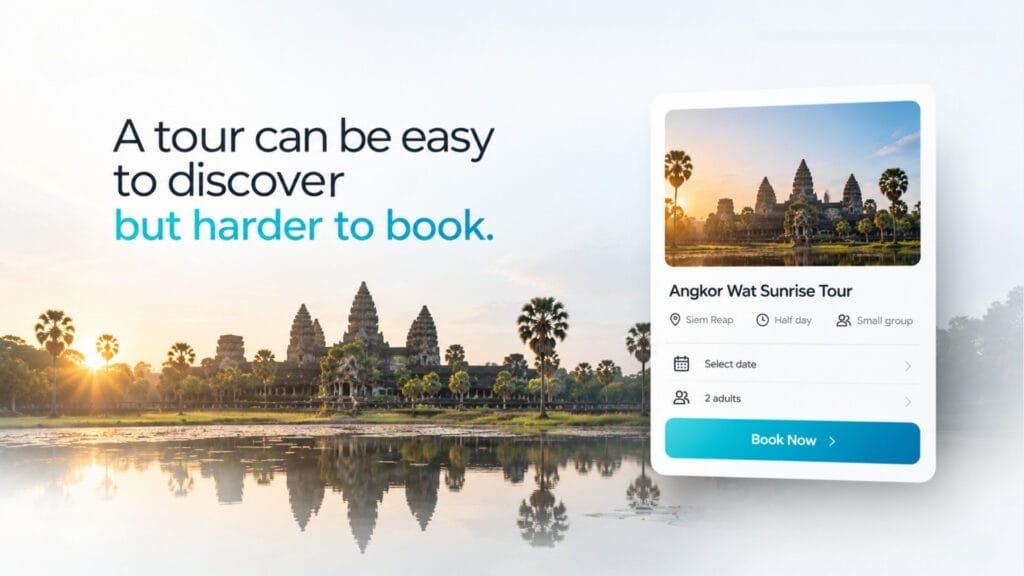
A tour can be easy to discover but harder to book.
A traveler might find a tour in seconds. They see the destination, understand the experience, read reviews and see a price. It feels like the decision should be easy.
But when they decide to book, the digital journey can change completely.
We looked at the journey behind the tour.
As part of SYNQFORM's research into Cambodia's tourism digital ecosystem, we expanded our research beyond hotels, spas and restaurants to look at tour operators.
We started with the Ministry of Tourism's public Tour Operators directory and used it as the starting point for a wider review of tour-operator digital journeys.
The public Ministry of Tourism directory currently displays 588 records under its Tour Operators category. This is a directory count, not a claim that Cambodia has exactly 588 unique active tour companies.
We studied what happens from discovery to confirmation.
The research looked beyond whether an operator has a website or a “Book Now” button.
We wanted to understand what a traveler experiences when they move from “This looks interesting” to “I want to book this.”
The booking journey can change after the customer decides to buy.
One of the clearest patterns from the research was the variation in how much certainty a traveler receives before committing.
Some tour operators provide a relatively connected path from tour selection through availability, booking, payment and confirmation.
Others use a hybrid approach, where the website handles discovery and product understanding while human communication remains an important part of the booking process.
Others remain much more contact-driven, moving the traveler into WhatsApp, Telegram, phone, email or a booking request before the reservation can be confirmed.
How much certainty does the traveler have before they commit?
Different systems create different levels of certainty.
Transactional
More of the booking journey is handled by the digital system, allowing the traveler to move forward with less human intervention.
Hybrid
The website supports discovery and decision-making while human communication remains part of the booking process.
Contact-driven
The digital presence helps the traveler understand the experience, while the actual transaction depends more heavily on direct communication.
None of these models is automatically better.
A customized private tour may genuinely require human conversation. A high-volume standardized experience may benefit from more automation. The right architecture depends on how the business actually operates.
The interesting part isn't the booking button.
It is what happens after the button.
Imagine a traveler sees:
“I want to book this tour.”
Then the questions begin:
Is it available on my date?
How do I reserve it?
How do I pay?
Is my booking actually confirmed?
Every unanswered question can introduce another moment of uncertainty into the journey.
Digital infrastructure changes where the responsibility sits.
If the system handles availability, payment and confirmation, more of the responsibility sits with the digital infrastructure.
If the customer needs to send a message and wait for a response, more responsibility sits with the customer and the staff.
Again, that doesn't make one model universally better.
The question is whether the chosen system fits the business and gives the traveler enough certainty to move forward comfortably.
The right booking architecture depends on the business.
A useful system needs to reflect factors such as:
- How many products are being sold?
- How frequently does availability change?
- How much customization does the experience require?
- How does payment work?
- How much human interaction does the experience need?
- How much operational control does the team need?
The SYNQFORM takeaway
A beautiful tour page can create desire. The booking system needs to turn that desire into certainty.
The question isn't simply: “Does this tour operator have online booking?”
The better question is: “How much uncertainty remains between wanting the experience and knowing it's actually booked?”
Discoverability gets the traveler interested.
Digital infrastructure helps them move forward.
Let’s look at your direct booking paths together.
If you want to review your current digital setup and see where your booking routes need strengthening, let’s have a practical conversation.