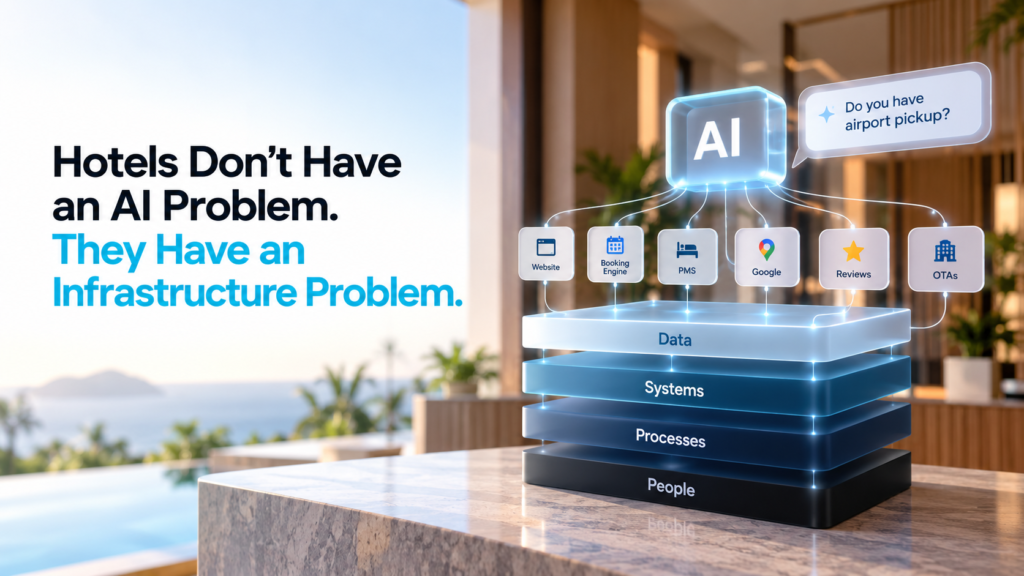
Hotels Don't Have an AI Problem.
They Have an Infrastructure Problem.
Everyone is talking about what AI can do for hotels. Far fewer people are asking whether the hotel is actually ready for AI.
Hotels are adopting AI faster than many of their underlying systems are being prepared for it.
That creates an interesting problem.
A hotel can have an AI chatbot, AI marketing tools, automated reporting, a modern booking engine and dozens of connected platforms and still have an infrastructure problem underneath all of them.
The issue is not necessarily the AI.
The issue is the information and systems the AI has to work with.
AI Adoption Is Moving Faster Than AI Readiness
The State of Hotel AI 2026 report surveyed 107 hotel company leaders and found that the biggest barriers to AI adoption were not primarily about AI models.
The major challenges included:
- Change management — 35%
- Data quality — 34%
- Systems integration — 29%
- Model limitations — only 8%
The same research found that only 42% of respondents were confident that their data was ready for AI, while 48% were not confident.
Even more interestingly, 70% of organizations with a defined AI strategy or governance structure still reported fragmented execution.
The problem is becoming less about whether hotels can access AI and more about whether their digital environment is ready to support it.
More AI Does Not Automatically Mean More Efficiency
Another 2026 study from NYU SPS, RateGain and HEDNA found that more than half of hotels are already using or procuring generative AI.
But fewer than one in ten reported more than a 30% reduction in manual work.
The research also pointed to fragmented data and disconnected systems as continuing problems.
This is important because adding another AI tool does not automatically remove the problems between the systems that already exist.
If the booking engine knows one thing, the website says another, Google contains an older version, the PMS contains something else, and staff have the latest information in a WhatsApp conversation, adding AI simply creates another layer on top of the problem.
A traveler asks:
“Does the hotel provide airport pickup, and how much does it cost?”
The website says one thing.
Google says another.
The booking platform has no information.
The front desk has the latest price.
If an AI assistant gives the wrong answer, AI did not create the underlying problem. It exposed it.
AI Is Only as Useful as the Information Underneath It
A hotel does not have one single source of digital information.
It may have:
- Website
- Booking engine
- Property management system
- Customer data
- Google Business Profile
- Google Maps
- Reviews
- Room information
- Pricing and policies
- Inventory
- Social media
- OTAs
- Analytics
- Internal documents
Each system may be useful by itself.
But usefulness is not the same as infrastructure.
Infrastructure is what happens when these systems, data sources and processes work together reliably.
More Technology Can Actually Create More Work
Every additional platform introduces another thing that needs to be maintained, connected, updated, monitored or reconciled.
This is why a hotel can have 20 digital tools and still have a weak digital infrastructure.
The question is not:
“How many technologies are we using?”
The better question is:
“Do our technologies and information actually work together?”
That distinction becomes increasingly important as AI starts interacting with business information on behalf of customers.
AI Changes the Requirement
Traditionally, businesses mainly needed their information to be understandable to people.
Now it increasingly needs to be understandable to machines as well.
Search systems, AI assistants, recommendation engines and booking systems need to interpret information about a business, connect different sources, compare options and sometimes help users take action.
Google is already moving in this direction.
Its AI Mode hotel experience allows travelers to discover and compare hotels using information such as reviews and other important hotel details before continuing toward booking.
Google has also been developing more agentic experiences that can help users complete local and travel-related tasks.
This means the digital environment around a business is becoming part of the customer journey — not simply a collection of marketing channels.
A Simple AI Readiness Test
Before asking what AI could do for your hotel, ask five simpler questions:
If the answer is “no” to several of these questions, buying another AI tool may not be the first thing the business needs.
Try the One-Customer-Question Test
Take one question a real customer might ask.
“Do you have airport pickup, and how much does it cost?”
Now check the answer across:
- Your website
- Google Search
- Google Maps / Business Profile
- Booking platforms
- Your booking engine
- Your staff
- An AI search experience
If all of them provide the same current answer, that is a good sign.
If they provide different answers, you have discovered something more important than an AI problem.
You have an infrastructure problem.
This Is Not Only a Hotel Problem
The same problem exists in other businesses.
A spa may have different treatment prices across Google, Instagram and its website.
A restaurant may have an outdated menu on one platform and a different menu on another.
A tour company may have different departure times across its website and booking platforms.
A clinic may have outdated service information appearing in search results.
In each case, AI simply makes the underlying information problem more visible.
Don't Start With AI. Start With the Infrastructure.
The next question for a hotel should not simply be:
“How can AI transform our hotel?”
A better question is:
“Is our hotel structured well enough for AI to actually help?”
Because the path from AI tools to business value is not simply:
AI → Results
It increasingly looks more like:
AI may be the visible part of the transformation.
But the infrastructure underneath it determines whether that transformation actually works.
Sources
-
Google — AI Mode introduces hotel booking
Google Search & AI Mode -
State of Hotel AI 2026 — Hotel AI adoption, readiness and infrastructure
State of Hotel AI -
NYU SPS / RateGain / HEDNA — State of Distribution 2026
NYU SPS Research