What Google Knows About Your Business May Not Come From Your Website
You control your website. You don't control everything Google knows about your business.
That distinction is becoming increasingly important.
A business may carefully write its website, update its services, publish new photos and make sure every page is accurate.
But when someone searches for that business on Google, the information they see can come from much more than the website.
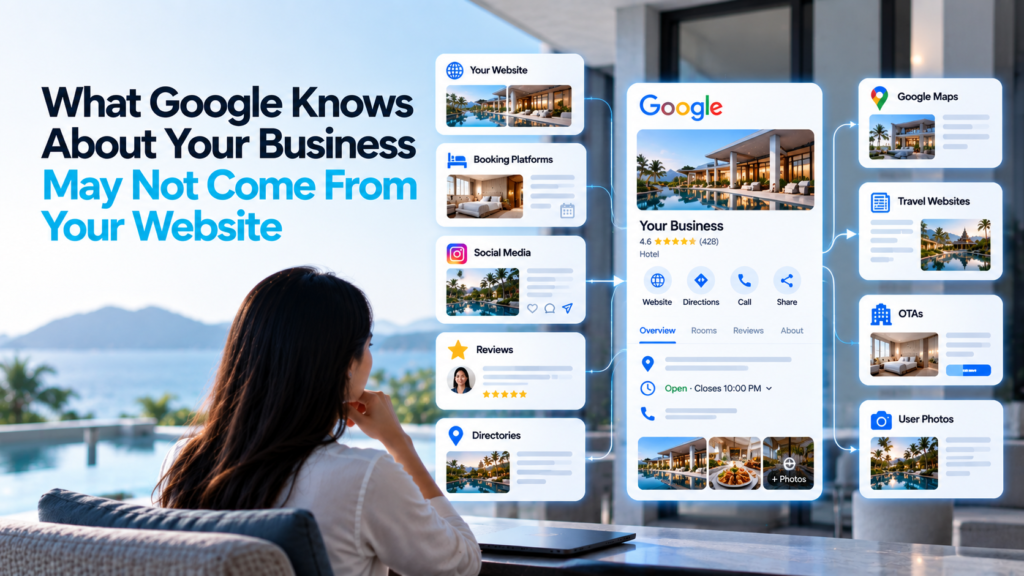
Google says Business Profile information can be compiled from publicly available web content, licensed third-party data, user contributions, business owners, and Google's own interactions with a business.
So there may be a gap between:
That gap is becoming a real business problem.
Your Website Is Your Voice. It Is Not the Whole Record.
Think about a hotel.
The hotel's website says:
Breakfast: 6:30 AM – 10:30 AM
But a third-party travel site says:
Breakfast: 7:00 AM – 10:00 AM
Google Maps has an old photo showing a restaurant that closed last year.
A review from six months ago says the airport transfer costs $15.
The current website says $20.
Instagram still promotes a package that ended three months ago.
None of these individual pieces necessarily look catastrophic.
But together, they create uncertainty.
Which information should a customer trust?
And increasingly:
Which information should an AI system trust?
Google Builds a Picture From Multiple Sources
This is not speculation.
Google explicitly explains that information in Business Profiles can come from:
- The official business website
- Other publicly available web content
- Licensed third-party data
- User contributions
- Business owners
- Google's own interactions with the business
Google also says it can update Business Profiles when information from different sources indicates that existing information is incorrect or outdated.
This changes how we should think about local search.
Your Business Profile is not simply a form you fill out once. It is part of a living information system.
The Website Can Say One Thing. The Ecosystem Can Say Another.
Imagine a restaurant launches a new concept.
The owner updates the website.
The new menu is published.
The branding looks perfect.
But six other places still contain the old information.
- Google has an old menu.
- A directory has the previous phone number.
- A travel website lists the old opening hours.
- An Instagram post still promotes last year's offer.
- A customer uploads a photo with the old menu.
The business thinks:
“We updated our website.”
The customer experiences:
“I'm seeing different versions of this business.”
That is not simply a website problem.
It is an information consistency problem.
And AI Makes This More Important
Traditional search often gave users a list of links.
The user could investigate the sources themselves.
AI-powered search increasingly tries to do more of the interpretation.
Instead of:
“Here are ten hotels.”
A user might ask:
“Which boutique hotel in Siem Reap would be best for a quiet couple's stay with a pool, good breakfast and easy airport access?”
Now the system has to interpret the question and match it against information about businesses.
Google is moving Search in this direction, including AI experiences and agentic capabilities designed to help users accomplish tasks rather than simply retrieve links.
That makes the underlying business information more important.
What Happens When Google Needs More Information?
There is another development worth watching.
Google can use automated calls to businesses in certain situations to confirm information or help complete customer requests.
Google says these calls can involve things such as services, availability and appointments, and information gathered through calls can be added to a Business Profile subject to Google's policies.
Think about the implication.
That means businesses are entering an environment where their digital presence needs to be understandable not only to customers, but potentially to systems that retrieve and verify information on the customer's behalf.
Your Digital Presence Has Layers
A business's information environment might look something like this:
Your website, booking system, Google Business Profile, official social accounts, own photos and service information
OTAs, directories, travel websites, local publications, industry platforms and partner websites
Reviews, customer photos, questions and answers, suggested edits and social posts
Google Search, Google Maps, AI Search, AI assistants and recommendation systems
The customer may encounter all of these.
Your website is only one layer.
This Creates a New Type of Digital Maintenance
Most businesses think maintenance means:
“Is my website working?”
But digital maintenance increasingly needs to ask:
“Is the information about my business still correct everywhere that matters?”
For a hotel, that could mean checking:
- Name
- Category
- Location
- Phone number
- Website
- Opening hours
- Room types
- Amenities
- Breakfast
- Airport transfer
- Pricing
- Booking links
- Photos
- Services
- Policies
- Reviews
- Third-party listings
This isn't about manually controlling every sentence on the internet.
That's impossible.
It's about identifying the important information and making sure the strongest sources are accurate, consistent and current.
The Most Important Information Is Not Always the Most Visible
A business might spend hours creating Instagram content while its Google Business Profile still has the wrong opening hours.
It might redesign its homepage while an OTA still shows an old room description.
It might spend money on advertising while customers receive conflicting information about its services.
This is why digital presence cannot be measured only by how attractive the website looks or how often a business posts.
There is another question:
Does the digital environment describe the business accurately?
Try the Five-Source Check
Pick one important customer question.
“Does your hotel provide airport pickup, and how much does it cost?”
Now check five places:
What does the official website say?
What does Search and Maps say?
What do customers see there?
Is there an old promotion or conflicting information?
What answer does an AI system give?
Now compare the answers.
If they all agree, excellent.
If they don't, don't immediately blame the AI.
You've found a digital information gap.
The Goal Isn't Perfect Control
There is an important distinction here.
You cannot control every piece of information that exists about your business.
Customers will write reviews.
Websites will publish articles.
Directories may contain old information.
People will upload photos.
Third-party platforms will maintain their own databases.
The goal is not:
Control everything.
The goal is:
That starts with your own authoritative sources.
This Is Bigger Than Google Maps
It's tempting to see this as another Google Business Profile task.
But the underlying issue is much bigger.
Google is simply one of the clearest examples because it already combines information from multiple sources.
The same principle applies to AI assistants, travel platforms, recommendation engines and other systems that need to understand businesses.
The business that maintains its information as a system is better positioned than the business that treats every platform as a separate marketing task.
The Digital Business Has an Information Layer
We usually think about a business like this:
But increasingly there is another layer sitting across all of them:
Your business creates information every day.
A room changes.
A price changes.
A service changes.
Opening hours change.
A new location opens.
A facility closes.
A promotion ends.
A new review appears.
A customer uploads a photo.
A third-party platform updates its listing.
All of these can affect how the business is understood online.
So digital presence is not something you build once.
It is something you maintain.
The Question Has Changed
The old question was:
“Does our website have the right information?”
The better question is:
“Does the digital environment have the right information about us?”
And the next question is even more important:
“Can the systems customers increasingly rely on understand which information is authoritative, current and trustworthy?”
That's where digital infrastructure becomes more than technology.
It becomes information governance.
Final Thought
You control your website.
You can manage your Google Business Profile.
You can correct your listings.
You can publish accurate information.
But you cannot completely control what the rest of the internet says about you.
That means the goal isn't to control every signal.
It is to build a strong, consistent and verifiable digital identity that gives search engines, AI systems and customers the clearest possible picture of the business.
Because in the next generation of search,
Sources
-
Google Business Profile — How Google sources and uses business information
Google Business Profile Help -
Google Business Profile — How Google updates Business Profiles from different sources
Google Business Profile Help -
Google — Search's 2026 AI and agentic updates
Google Search & AI -
Google Business Profile — Automated calls and information gathering
Google Business Profile Help