
Hotel Online Presence: What We Found Across 10 Cambodian Hotels
A hotel’s online information can tell different stories depending on where a guest looks. In this review, we found room descriptions that disagreed, phone links that did not lead where expected, and check-in information that changed between a hotel website and an OTA listing.
At SYNQFORM, we are building an evidence record across ten hotels in Phnom Penh and Siem Reap. We use our master assessment framework to examine how each business is discovered, understood, contacted and booked.
Here are five recurring issue families documented so far, along with what the wider channel checks revealed.
1. How we collected the evidence
We started with official hotel websites, inspected selected pages and their source information, and followed public contact and booking routes. We also examined Google hotel listings, Facebook profiles and online travel agency listings.
For each observation, we kept the business reference, source URL, capture date, finding and verification limit in one research spreadsheet. Supporting page captures allow us to trace a finding back to its source.
The current evidence covers:
- Website homepage captures for all 10 hotels, alongside earlier checks of selected pages and booking journeys.
- Live OTA listings for all 10: eight on Agoda and two on Booking.com.
- Google hotel listing snapshots for 9 hotels.
- Readable public Facebook profiles for 9 hotels.
- Review-score snapshots, rather than a complete analysis of reviews or management responses.
One linked Facebook route required sign-in, and one Google listing remained unverified. We did not count either limitation as a hotel error.
Our master framework covers 17 assessment areas and more than 100 evidence checks. These ten records are partial assessments; none is a completed full master audit. This is a small research sample, not a measure of Cambodia’s hotel industry.
2. Five recurring issues in the records
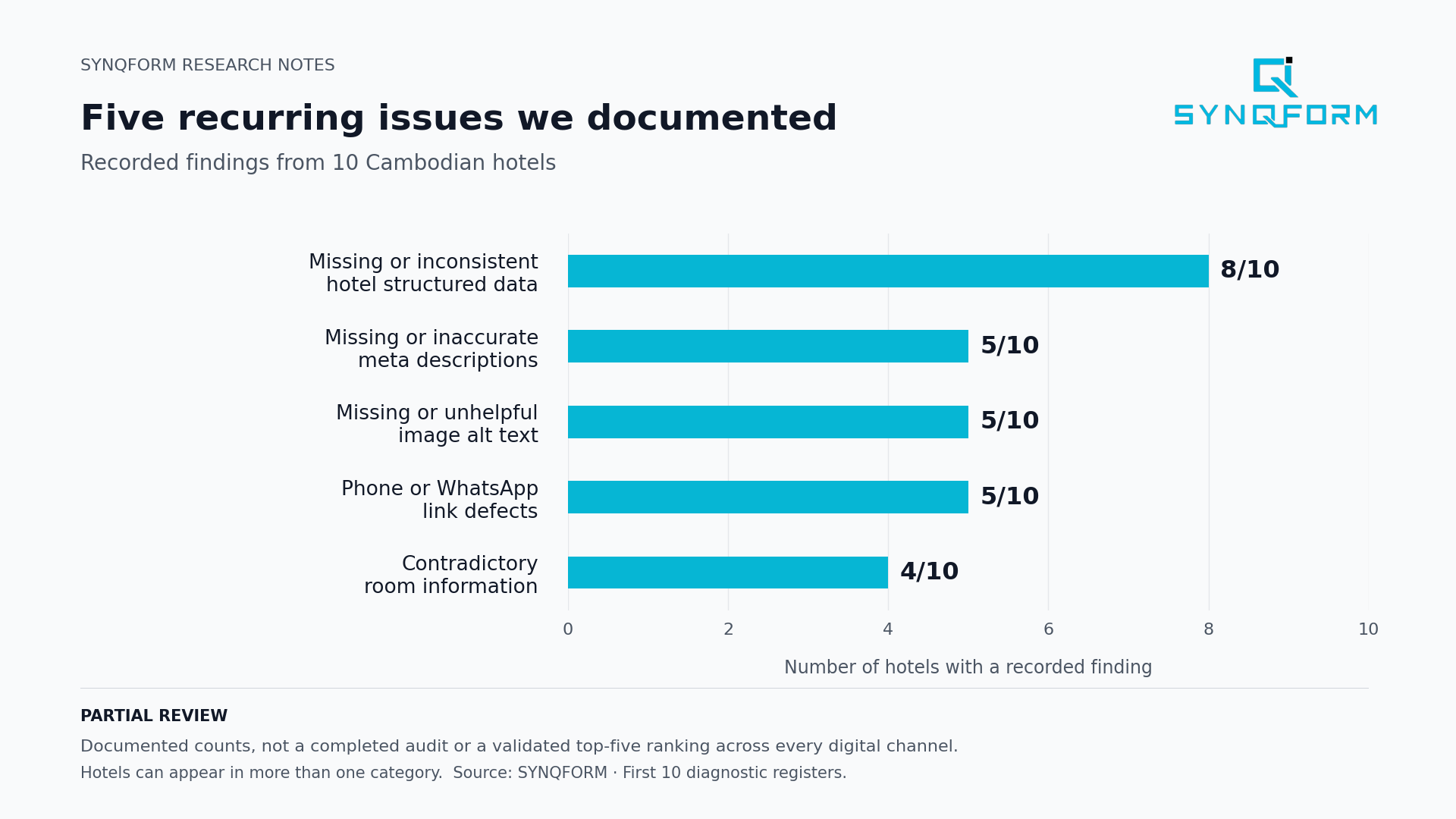
The chart counts distinct hotels with a documented finding in each family. A hotel can appear in several categories. The counts describe the evidence collected so far; they are not a validated ranking of the five most common problems across every channel.
8 of 10: Missing or inconsistent hotel structured data
In eight records, sampled pages had missing or inconsistent hotel structured data—the machine-readable information used to describe a property.
One example contained coordinates set to 0,0. Other records lacked hotel-specific markup on the pages inspected.
These observations identify information that needs checking. They do not prove that a hotel is absent from Google or AI search, or that adding markup alone will improve bookings.
5 of 10: Missing or inaccurate meta descriptions
Five records contained missing or inaccurate descriptions on sampled pages. These descriptions can help explain a page in search results.
The finding is about the page information we inspected. Google can generate a snippet from other page content, so a missing description does not mean a hotel has no search-result description.
5 of 10: Missing or unhelpful image alt text
Five records contained missing or unhelpful alternative text on sampled images.
Hotel photography communicates practical details about rooms and facilities. When the alternative text is absent or generic, that detail may not be available to someone using a screen reader.
We recorded the affected examples; we did not complete a full accessibility assessment of each website.
5 of 10: Phone or WhatsApp link defects
Five records contained contact-link issues. Examples included WhatsApp destinations without a country code, a displayed phone number that differed from its linked number, and phone text without a click-to-call link.
These are different levels of friction: a wrong destination is different from a number that a guest must copy manually. We kept those distinctions in the records.
We inspected the published routes without calling the hotels or sending messages. We therefore make no claim about response times or failed enquiries.
4 of 10: Contradictory room information
Four records contained disagreements about room counts, beds, sizes or capacities.
In one example, a homepage described 28 guestrooms while a room page described ten. Other examples involved conflicting bed descriptions or differences between website and direct-booking room information.
We can establish that the published descriptions disagree. The hotel must confirm which description reflects the actual accommodation.
3. What the wider channel checks revealed
The broader review also found discrepancies outside the website.
For one hotel, the website published a 2 pm check-in time while Booking.com listed a check-in window starting at 9 am. For two hotels, Google and Agoda displayed different postal codes even though the main street locations matched. Another hotel appeared with five stars on Google and four on Agoda.
These observations require different responses. The check-in information needs reconciliation. Postal codes and classifications need confirmation before we label either platform’s version incorrect. Different contact numbers or a shared sister-property social account can also be legitimate.
This is why SYNQFORM is building a connected evidence record across websites, search, social profiles, OTAs and booking routes. We want to identify exactly where information diverges, retain the evidence, and establish what needs correction or clarification.
The next stage is to complete comparable channel checks and verify the unresolved facts. We have not measured lost bookings, revenue impact or changes in guest trust.
For hotel owners and managers, this review offers a practical starting point: compare the information a guest sees across your channels, especially room details, arrival policies and contact routes.
Research note: Prepared with AI assistance. Source records and capture dates are retained for verification. Public information can change after collection.