Cambodia Spa Digital Presence Study 2026: What Approximately 102 Public Listings Already Reveal
When we started collecting spa and wellness businesses across Cambodia, the original goal was simple: build a useful working population, then manually inspect the digital presence later.
Our Cambodia Spa Digital Presence Study 2026 market is not built in one standard way.
Some spas have their own official website. Some live mainly through Google Maps and travel listings. Some are strongly social led. Many hotel spas sit inside the hotel’s own website rather than operating as a separate digital brand.
That sounds obvious until you think about what it means for a customer trying to discover, compare and trust a spa.
There is no single digital front door
Across our working population of approximately 102 spa, massage and wellness businesses, we repeatedly found several different digital models.
Independent spas such as Bodia Spa, Cholsa Spa, Samatha Spa, The Spa Siem Reap, Nibi Spa and Lomchang Spa operate with their own official websites.
Hotel spas such as Jivapita Spa, Sense, A Rosewood Spa, Raffles Spa, Sofitel Spa, Moringa Wellness Spa and Season Spa live inside a larger hotel or resort ecosystem.
Another group is publicly visible mainly through Google Maps, travel directories, Facebook or other social channels, without an identifiable standalone website in our current research pass.
This does not automatically mean one model is good and another is bad.
But it does mean customers can enter the same market through very different digital journeys.
One guest may discover a spa through a polished website with treatment pages and booking information. Another may find only a Maps listing, phone number and reviews. Another may land on Facebook. A hotel spa customer may never see a spa specific brand at all, only a section inside the hotel website.
For business owners, this matters because being online is not one thing.
Maps visibility is not the same as having an owned website. A hotel spa page is not the same as a standalone spa brand. A Facebook page is not the same as a controlled information hub. An official website is not automatically useful just because it exists.
Cambodia’s spa market is digitally fragmented
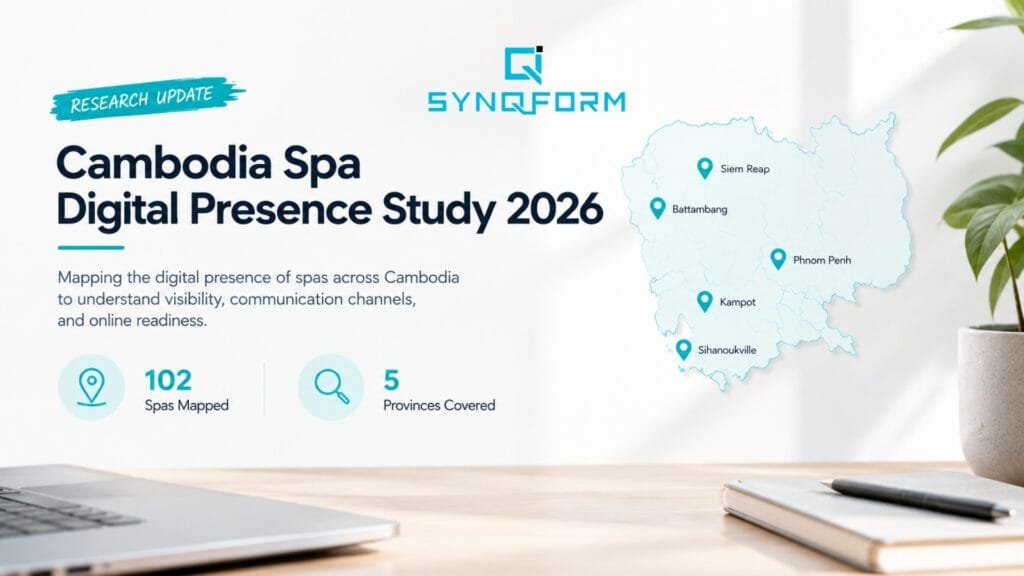
Our current research covers mainly Phnom Penh, Siem Reap, Battambang, Kampot and Sihanoukville, with a few multi location brands crossing cities.
The strongest concentration in the working dataset is clearly around Phnom Penh and Siem Reap, while the other destinations show a smaller but still visible spa and wellness market.
What is interesting is not only where businesses are located, but how discoverability changes by business type.
Independent spas often need to build their own digital identity from scratch. Hotel spas can borrow authority, traffic and infrastructure from the hotel brand. Massage businesses may rely heavily on Maps, reviews and direct phone contact. Wellness centres sometimes sit somewhere between hospitality, beauty and health oriented positioning.
So when people talk about spa digital marketing as if every spa needs the same checklist, the market itself suggests otherwise.
The digital foundation should probably depend on the business model.
What we can trust now and what we cannot yet claim
There are several things this first layer of research supports with reasonable confidence.
We can say that our working sample contains a meaningful and diverse publicly discoverable spa and wellness population across multiple Cambodian destinations.
We can say that businesses use different public digital structures: standalone websites, hotel parent websites, social led presence, Maps and travel platform visibility.
We can say that hotel spas and independent spas should not automatically be evaluated using exactly the same digital criteria.
We can also say that some businesses are easy to verify across several public sources, while others require much more manual work to determine whether the information is current, duplicated or connected to another branch.
What we cannot responsibly say yet is the exact percentage of Cambodian spas that own a website, the exact national number of spa businesses, or that a business without a standalone website is underperforming.
Those conclusions need the human verification stage.
That is exactly why we are keeping the research open.
Why this matters for spa owners
If you run a spa, the useful question is probably not, “Do I have enough social media?”
A better question is, “If someone hears my spa name today, can they quickly understand what I offer, where I am, how to contact or book, and whether the information they find is consistent?”
That journey might happen through your website. It might happen through Google. It might happen through a hotel website. It might happen through Facebook or a travel platform.
The customer does not care which system your business prefers internally.
They only experience whether the information is easy to find and easy to trust.
That is the part we want to study next.
SYNQFORM research note
This Insight is based on SYNQFORM’s working Cambodia Spa Digital Presence Study 2026, which currently contains approximately 102 publicly discoverable spa, massage and wellness business entries collected from official websites, Google Maps, social profiles, hotel ecosystems, travel listings and current directory evidence.
The working population is still being manually verified and deduplicated. It should not be treated as Cambodia’s official spa population. For that reason, this article intentionally avoids national market share percentages or claims that the working list represents every operating spa in Cambodia.
The next stage will manually verify current operation, website ownership, branch relationships, information consistency and customer facing digital journeys before SYNQFORM publishes stronger quantitative findings.