
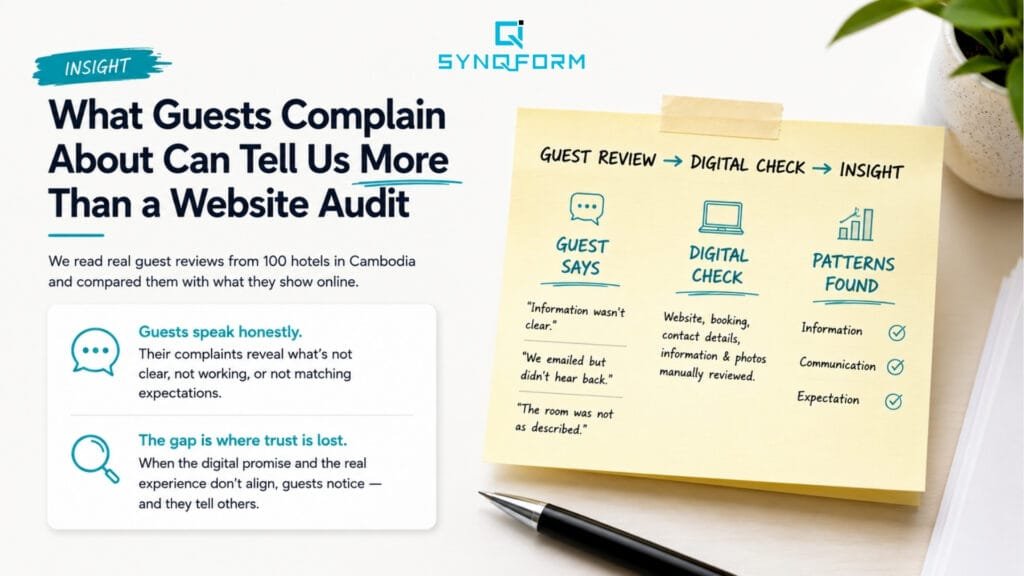
What Guests Complain About Can Tell Us More Than a Website Audit
When we first compare hotel guest complaints via reviewing Cambodian hotel websites, we mostly looked at what we could see ourselves.
We found broken booking links, outdated airport information, old promotions, different information across pages and unclear contact routes.
Those findings were useful. But recently we started asking a different question.
Are these only problems that we notice as digital reviewers, or are guests actually feeling some of them too?
So we went back to the same hotels in our first 100 hotel website study and started looking at public guest reviews, questions and management responses alongside our original website findings.
That changed the way we looked at the research.
Sometimes the guest complaint and the digital problem tell the same story
One of the clearest early signals is consistency.
A guest will not normally describe a problem as inconsistent digital infrastructure. Their review or question may instead reveal uncertainty about what is included, whether a room has a particular feature, how transport works, which policy applies or why an email received no reply.
That language matters because it describes the customer’s experience rather than the technical condition of a page.
At Samanea Beach Resort & Spa, public reviews show that guests value staff support and transport arrangements. Its own pages also show why small wording differences deserve attention. The reservation page describes free tuk tuk transfers to and from the city centre twice daily, while the contact page describes complimentary transfers to the Crab Market and Main Beach for direct bookings. The guest review page remains strongly positive. This does not prove that customers are being harmed, but it shows that transport is valuable enough for the public wording to be kept consistent.
In another example, a prospective guest asked a public question about The Royal Sands Koh Rong after reporting that an email had not received a reply. The guest wanted to know whether the villa shown in photographs included a bathtub. A property representative clarified the room information manually. The hotel’s current official pages now distinguish villa features more clearly, including the Ocean View Pool Villa, Deluxe Pool Villa and other room categories on the official website.
This is useful evidence of pre booking information friction. It is not evidence that the hotel has a generally weak digital journey. In fact, our earlier review treated the overall official journey as a positive benchmark.
We also found the opposite
Some hotels had very strong guest feedback even when we could still see unfinished website content or inconsistent information.
Hôtel KVL, for example, had a visible website content issue during our earlier research pass, but its guest review profile was overwhelmingly positive about its location, rooms, cleanliness and service.
We saw a similar contrast at Soma Hotel Riverside. A public room page exposed a booking plugin message during our website review, while guest feedback on Tripadvisor and Agoda remained strongly positive in the review sources checked.
Positive counterexamples matter. They stop us from forcing every website observation into a customer pain story.
A website problem does not automatically mean a customer problem.
A customer complaint does not automatically mean the website caused it.
The useful question is whether the two pieces of evidence connect.
This is why digital quality is bigger than fixing a broken page
For hotel owners and managers, there is a practical lesson here.
Your guests may move through Google, an online travel agency, the hotel website, email, WhatsApp, booking, arrival, the stay itself and finally a review platform.
If the information changes somewhere along that journey, the guest usually does not know which department or platform caused the problem.
They simply experience confusion.
That might be a room description that does not match what they expected, a promotion that remains visible after it expires, an airport transfer condition explained differently on two pages, a contact route that exists but receives no response, or a policy that appears differently online and at the property.
Individually, these can look like small issues.
When we compare guest voice, public information and the actual digital journey, they become more useful signals.
Jaya House River Park provides a useful positive contrast. Its guest reviews repeatedly praise transport planning, airport pickup and proactive communication. Its official website also explains the current airport distance and transfer conditions. Here, customer voice helps identify which information guests value, not only what they dislike.
That is the direction we want to take SYNQFORM’s research now.
The goal is not to find as many website mistakes as possible.
The better question is, “What are guests telling businesses, and can the digital journey help explain where some of that friction comes from?”
That gives hotel teams something more useful than another technical checklist.
It gives us a way to separate operational problems, digital information problems and situations where both may be connected.
That is where better digital maintenance starts.
Not with fear. With listening.
SYNQFORM research note
This Insight is based on SYNQFORM’s ongoing manual review of 100 selected Cambodian hotel digital presences, combined with a newer research layer examining publicly available guest reviews, questions and management responses.
The guest review pass across all 100 hotels is not finished. The examples above are early observations from the hotels reviewed so far. They should not be treated as statistics representing Cambodia’s hotel industry.
Review comments are treated as individual customer accounts, not independently proven facts. SYNQFORM compares them with public business information to identify possible connections, positive counterexamples and questions that deserve further verification.
The research does not claim that digital issues caused every customer complaint. It also does not assume that every visible website issue creates measurable customer harm.