
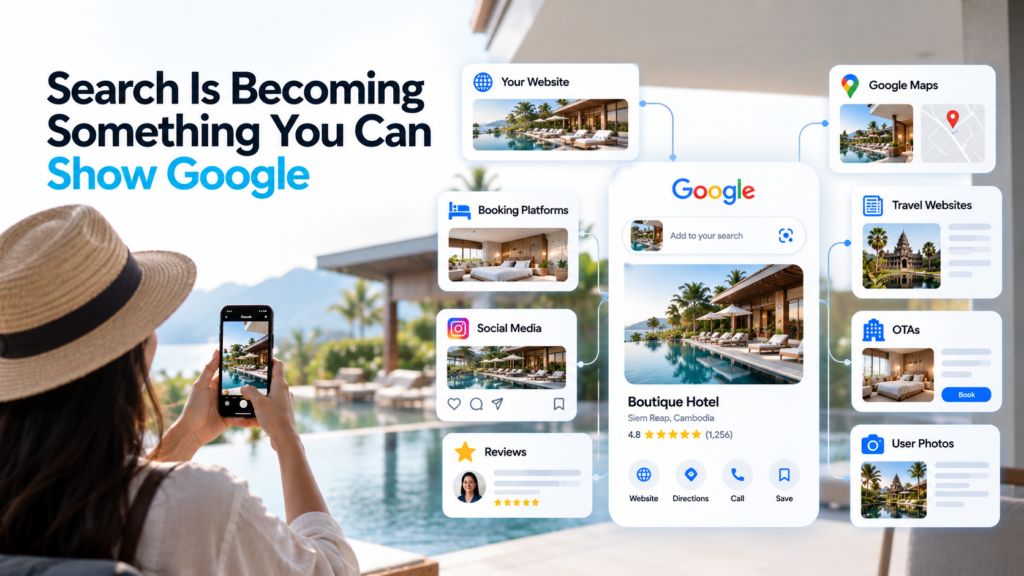
Search Is Becoming Something You Can Show Google
What if your customer doesn't type what they're looking for?
They show it.
A photo.
A screenshot.
A room.
A building.
A product.
An outfit.
A place they want to find.
Search is becoming increasingly multimodal — combining text, images, and visual understanding.
Google has been expanding this through Lens, Circle to Search and AI Mode. In September 2026, Google also added multimodal search reporting to Search Console, allowing site owners to see traffic from Lens, Circle to Search, image uploads and Chrome's “Search this image” feature.
That changes an assumption many businesses still make:
People don't always search for your business by typing your business category.
They may search by showing Google something.
Imagine a hotel guest.
They see a beautiful pool on Instagram.
They want something similar.
Or they photograph a hotel lobby while travelling.
Or they see a room design they like and want to know:
“Where can I find a hotel like this?”
The search doesn't necessarily begin with:
“Best boutique hotel in Siem Reap.”
The image itself can become the starting point.
Google's visual search systems can identify objects, understand scenes and connect visual information with other search results. Circle to Search has also expanded to identify multiple objects within a single image.
This creates a new question for businesses:
Can your visual content be understood outside the context of your website?
A beautiful photograph is not automatically a useful digital asset.
The system needs context.
- What is the place?
- Where is it?
- What does it offer?
- Who is it for?
- What makes it different?
- Is the image actually associated with the correct business?
- Is the information around that image still accurate?
The Visual Layer of Your Digital Presence
For a hotel, this might include:
Rooms, property, facilities, location
Business identity, photos, location and reviews
Room types, amenities and property photography
Lifestyle imagery and experiences
Real-world visual evidence
Editorial and destination context
Interpretation and connections between these sources
These aren't separate pictures floating around the internet.
Together, they can become part of how a system understands the business.
This Doesn't Mean “Do More SEO”
That's the easy answer.
The more interesting question is:
What does your visual content communicate?
Consider two hotel photos.
Hotel A
- Beautiful pool photograph.
- No useful context.
- Generic filename.
- No clear relationship to the property.
- Old image.
- Different pool shown elsewhere.
Hotel B
Pool photograph connected to a clearly identified property, consistent location information, current facilities, descriptive content and supporting evidence across its digital presence.
Both have beautiful photos.
But they don't have the same digital meaning.
Search Is Moving From Keywords Toward Context
Traditional SEO often starts with:
What keyword should we rank for?
Visual and AI-powered search introduces another question:
What can this content help a system understand?
That doesn't make keywords irrelevant.
It means keywords are no longer the entire interface between people and information.
Google itself now gives site owners visibility into multimodal search performance because search is becoming more visual.
Read the Google Search Central update
That is significant.
Because you can now begin asking:
- Which visual searches are finding us?
- Which images receive visibility?
- Which pages are connected to that traffic?
- Are our images describing the right thing?
- Are our visual assets consistent with our actual business?
- What happens when someone searches using an image rather than words?
A Simple Test
Pick five important images from your business.
Then ask:
- What is this image showing?
- Which business does it belong to?
- Where is it?
- What does it tell someone about the business?
- Is the same information supported elsewhere online?
- Is the image still accurate today?
If your team cannot answer these quickly, the problem may not be the photograph.
It may be the information infrastructure around the photograph.
The Bigger Shift
For years, businesses thought about digital visibility primarily through:
The environment is becoming more complicated:
People can increasingly start with something they see, not something they type.
And that means digital discoverability is becoming less about putting the right words on one webpage and more about creating a clear, connected information system around the business.
Your images are part of that system.
Your website is part of that system.
Your Google profile is part of that system.
Your reviews are part of that system.
Your booking platforms are part of that system.
And increasingly, AI is learning from the connections between them.
The question is no longer only:
“Can people find our website?”
“Can search understand what it is seeing?”