A Hotel Website Can Look Finished — And Still Be Out of Sync.
A hotel website maintenance can look modern, load correctly and present beautiful rooms. That does not necessarily mean the digital journey behind it is still working as intended.
This Insight comes from SYNQFORM's recent observation of 20 hotel digital journeys in Siem Reap, where different customer-facing issues pointed toward a broader question: what happens when the systems behind a website gradually stop working together?
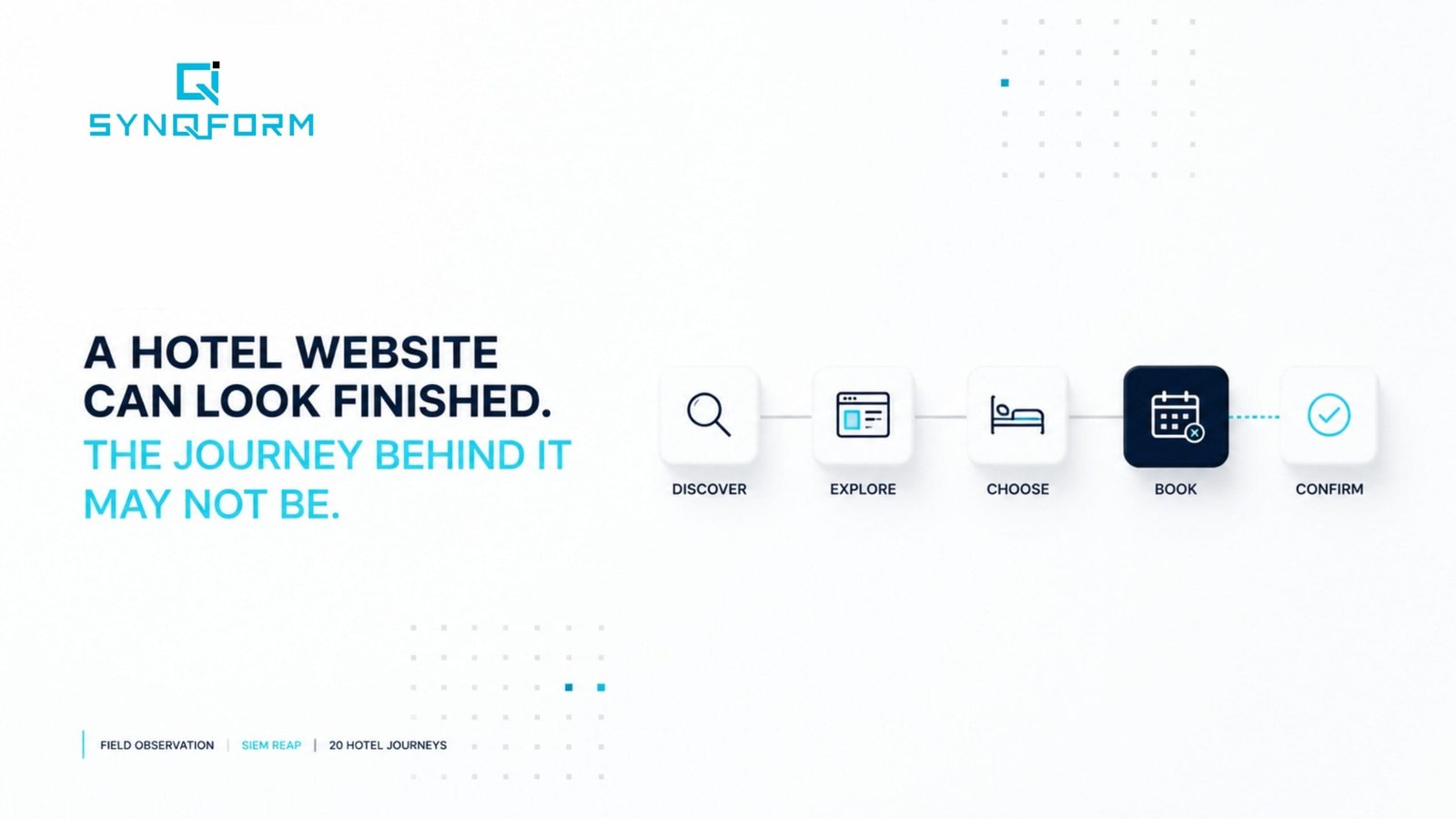
THE CUSTOMER JOURNEY
A website does not operate alone.
For a traveller, the journey may look simple:
Behind that journey, several systems may be involved.
Google may provide the first information. The website explains the property. Room details may be maintained separately. Promotions change. A third-party booking engine may handle reservations. Contact information may exist across several pages and platforms.
Each part can work independently. The problem begins when they stop working together.
FIELD OBSERVATION · SIEM REAP
Small inconsistencies can appear anywhere in the journey.
During our recent review of 20 hotel digital journeys in Siem Reap, we observed different forms of friction across the hotels reviewed.
Information
Outdated or conflicting information remained visible across parts of the journey.
Connected Systems
Information did not always remain consistent between the website and connected systems.
Customer Actions
Some actions did not lead where a first-time customer would reasonably expect.
Booking Journey
Some booking-related paths introduced unnecessary uncertainty at a high-intent moment.
None of these observations automatically means a hotel is losing bookings. Without access to the hotel's analytics, that would be an assumption.
What we can observe is friction in the customer's journey.
LOOK BEYOND THE ERROR
The deeper problem may be maintenance, not design.
If a booking button fails, the immediate solution may be to repair the button.
How did an important customer action remain incorrect without being noticed?
Websites are often treated as projects:
But a hotel's digital presence behaves more like operational infrastructure. Airport access changes. Policies change. Offers expire. Room information changes. Staff and contact details change. Booking systems are replaced. Google information evolves.
A website that was completely accurate when launched can gradually become fragmented without ever appearing visibly broken.
CHANGE THE VIEWPOINT
Experience the journey, not just the homepage.
One practical way for hotel teams to detect friction is surprisingly simple: periodically behave like a first-time guest.
Search for the property instead of entering the website directly.
See what Google presents before the guest reaches the website.
Open the website on a phone and try to understand the property quickly.
Find a room, check an offer and review location or arrival information.
Press the important calls to action and enter the booking journey.
Compare what the booking system says with what the website says.
Don't hunt for mistakes. Experience what a real guest encounters today.
This perspective matters because internal teams naturally become familiar with their own systems. A first-time traveller does not have that familiarity.
SYNQFORM PERSPECTIVE
Digital infrastructure needs continuous alignment.
A professionally designed website remains important. But design is only one part of the system.
For the customer, Google, website content, room information, booking technology, contact channels and the confirmation experience form one connected journey.
Maintaining that journey requires more than occasionally redesigning the website. It requires checking whether the different pieces remain accurate, connected and measurable as the business changes.
“Does the website look good?”
“Does the digital journey still work as one system from the customer's point of view?”
A website can look finished. The journey behind it may not be.
See your digital presence from the customer's side.
SYNQFORM reviews the connected journey behind your online presence to identify where clarity, trust and customer experience may be weakening.