SYNQFORM

Free Digital Check

SYNQFORM Insight

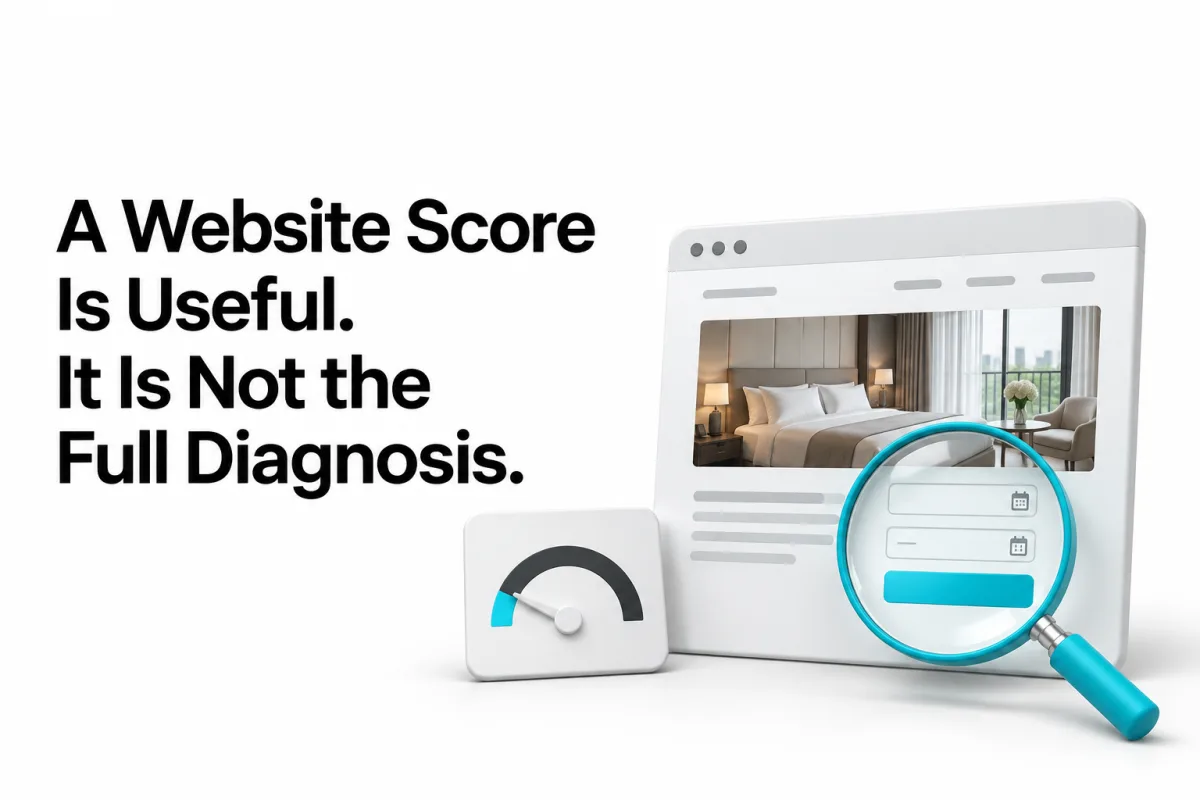
A Website Score Is Useful. It Is Not the Full Diagnosis.

Illustration of a hotel web page with a score gauge and a magnifying glass looking closer at the page.

Website tools can show us where to look. They cannot confirm whether the information is correct, the booking journey makes sense or a real guest can complete what they came to do.

Quick learning 4-minute read Based on 20 hotel reviews
Automated report Test complete
63 out of 100

Example performance snapshot

Useful evidence, but not a final conclusion.

Manual diagnosis Still required
01

Verify the finding on the live website

02

Follow the real guest and booking journey

03

Confirm the customer or business impact

Score + verification + context

During our review of 20 hotel websites score in Siem Reap, testing tools helped us find technical signals that deserved attention.

Some led us to real website problems. Others needed more investigation. A few sounded serious in a report but were not strong enough to use as evidence.

If we treated every warning as a confirmed defect, the diagnosis would be unfair.

Start with the signal

A score gives us a place to look.

Lighthouse and similar tools can identify possible problems with performance, accessibility, SEO and website structure. Without them, some technical signals would be difficult to notice manually.

But the result is a snapshot taken under particular conditions. The device, network, server response, cache and time of the test can all influence what appears in the report.

This is why we record when the test was completed and use the result as supporting evidence—not as a permanent description of the website.

A low score tells us to investigate. A high score does not prove that the complete guest journey is working.

Website test result Snapshot
01
Useful evidence A result from one test

It records what the tool detected under those conditions.

Conditions that may influence the result

01 Device and screen
02 Network conditions
03 Server and cache
04 Time of the test

Signal or conclusion?

Some automated warnings sound stronger than they are.

Testing tools can produce long lists of warnings. The difficult part is deciding what each finding proves and whether it has a real effect on the customer or business.

01
Detected signal

JPG images found

Does not prove

That the images are automatically heavy or slowing down the website.

Verify

Check the actual file size, dimensions, compression and loading behaviour.

02
Detected signal

Missing link title

Does not prove

That the link is broken or that the page has a serious SEO defect.

Verify

Open the link and confirm that its visible text and destination are clear.

03
Detected signal

Older technology detected

Does not prove

That the CMS or website is defective simply because it is older.

Verify

Check updates, security, compatibility and whether maintenance has become difficult.

04
Detected signal

Historical analytics detected

Does not prove

That measurement or analytics tracking is currently broken.

Verify

Inspect the live tracking setup and test whether current events are being recorded.

A warning can be a useful reason to investigate. It should not be presented as a confirmed defect until the live website has been checked.

Evidence changed the decision

One review taught us when not to approach.

During the Siem Reap research, one hotel website received a Lighthouse performance score in the low 60s. We also noticed a few minor wording issues.

From those findings alone, it would have been easy to prepare an outreach message. But we continued checking.

The website had Google Analytics 4, structured SEO information, caching and Cloudflare. All 49 images detected during the review had ALT descriptions. Its content and booking journey were also generally well managed.

The score was real, but it was not enough to support a strong diagnosis. We removed the hotel from outreach and kept it as a quality benchmark instead.

Good research should not only tell us when to offer a service. It should also tell us when the evidence is not strong enough.

Anonymous hotel review Identity protected
01
Initial signals

Reasons to investigate

Performance score in the low 60s Minor wording issues
02
Further verification

Evidence of active website management

✓

Google Analytics 4

✓

Structured SEO data

✓

Caching and Cloudflare

✓

ALT descriptions on 49 detected images

✓
Final decision No outreach based on weak evidence. Retain the website as a quality benchmark.

Beyond the report

A score cannot follow the complete guest journey.

A guest does not experience a website as a technical report. They open it on their phone, check the rooms, location and facilities, and decide whether they trust the hotel enough to continue.

They may compare the website with Google, social media or a booking platform. They may also leave when something feels unclear, even when the website has a good technical score.

This is why human journey testing must continue after the automated report ends.

01

Does the website information still match the hotel’s current operation?

02

Can a guest move from the room page to the booking engine without confusion?

03

Does the mobile menu still work when pop-ups or floating tools are open?

04

Do testimonials, awards and social feeds still belong to the correct property?

05

Does an enquiry reach the right person, and can the hotel measure what happened?

These questions require someone to use the live website in the same way a real guest would.

Our review process

How we use website tools at SYNQFORM.

We still use Lighthouse, SEO checks, technology detection and measurement tools. The difference is that the tool does not make the final decision.

01

Find the signal

We use technical tools to identify something that may need attention. This could be a performance result, missing element, failed connection or unusual page behaviour.

02

Verify it manually

We return to the live website and try to reproduce the issue. We check other pages, devices and customer routes when necessary.

03

Explain the real impact

When the issue is confirmed, we connect it to trust, discoverability, communication, booking continuity, measurement or maintenance.

Confirmed defect or observation requiring verification?

If we cannot reproduce an issue, we do not present it as a confirmed defect. It remains an observation until stronger evidence is available.

The useful lesson

Before reporting a website problem, ask what the evidence proves.

Website scores are helpful. The problem begins when the number becomes the entire diagnosis.

Our review of 20 hotel websites made our own process stricter. We still use technical tools, but we combine them with content accuracy, mobile usability, booking continuity, trust and enquiry testing.

This helps us separate a confirmed defect from an observation that still needs verification.

✓

Can we reproduce the issue on the live website?

✓

Is it confirmed, or is it still only a signal?

✓

What evidence supports the finding?

✓

How could it affect the customer or the business?

✓

Is it important enough to act on now?

The score helps us know where to look. The customer journey helps us understand what matters.

A practical next step

Not sure what your website score actually means?

Start with the complete customer journey before deciding that the website needs another tool, repair or rebuild.

This Insight is based on SYNQFORM’s manual review of 20 hotel websites in Siem Reap. Individual properties remain anonymous because the purpose is to share useful research lessons, not publicly judge a business.